The Context of it All
Chapter Two
This might be a good time for a refresher on ideology – and the ridiculous number of names we use to describe our politics.
Of course, most of us know the terms Liberal and Conservative, as in Canada’s two major political parties, the capital C Conservatives and the capital L Liberals.
I emphasize the capitals because, in that context, I’m referring to a political party rather than an ideology.

But aren’t the Conservatives conservative and Liberals liberal?
Yes!
Sort of.
Sometimes.
Well, actually, it’s pretty complicated.
Let me explain.
Politics, if you remember, is about decision-making power, but it’s also about the organization of our lives.
Think of ideology as an extension of just that: it’s the collective philosophy and values of the decision makers in power, but it’s also a way to organize how groups of people think.
And, as humans, we love organization.
Though conservatism and liberalism are seen as the two most predominant ideologies in our society, ideology is so much more complicated than that because, well, the human brain is so darn complex.
Traditionally, in Canada, we’ve viewed ideology as a line: the left-right axis.

If you turn left at centre, we find liberal thinking – those who are more focused on the collective good and believe that good is accomplished with the support of a strong central government or what’s known as the welfare state.
The further left you go on the axis – the more left wing you are – the more you believe in the role of government to ensure that society as a whole is equal.
That can be known as socialism – which is both an ideology and an economic model. And though that’s a hard left philosophy, it’s not the extreme end of left-wing politics – that’s communism!
Communism, for the record, is also a form of totalitarianism and authoritarianism because it’s an anti-democratic dictatorship that imposes extreme left-wing politics – think the former Soviet Union or present-day Cuba.
Now, let’s say you turn right at centre: Here we find conservatism – those who are more focused on the traditional rights of the individual and believe that good is accomplished through the promotion of free enterprise and a decentralized, small government.
The further right you go on the axis – the more right-wing you are – the more socially conservative or traditionalist you are; the more you believe in protecting cultural or religious beliefs from secularism. Usually.
At the most extreme end of conservatism, you find fascism.
Fascism, for the record, is also a form of totalitarianism and authoritarianism because it’s an anti-democratic dictatorship that imposes extreme right-wing politics – think Nazi Germany or Mussolini’s Italy or, some argue, present day Russia.
And you know all this stuff, but like I said, it’s a refresher before I confuse the heck out of you.
Huh?
Well, to really understand ideology, you kind of need to take a VR headset to the axis. Ideology, after all, is evolving and the only way to understand the changes is to look beyond the traditional left-right axis.
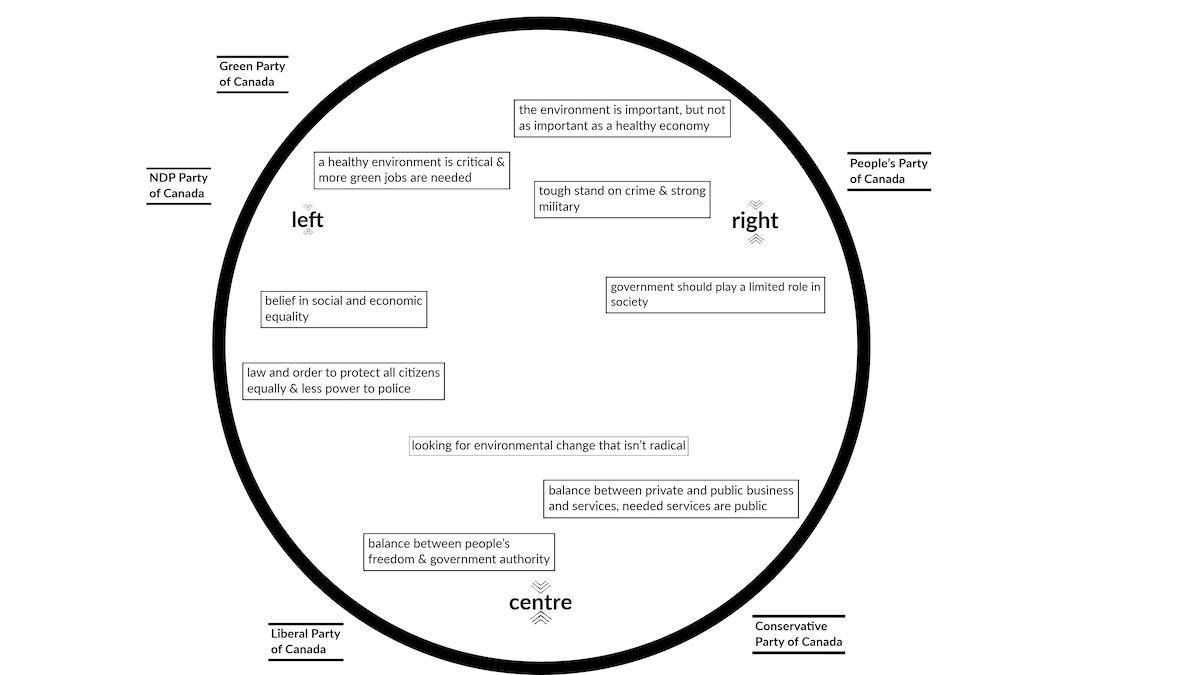
Some now see ideology as a box. Or a circle. Or a bunch of triangles. Or a bunch of circle-ish shapes inside of boxes. Or, well, everyone has a theory because, again, it’s as complex as our minds. You should explore the theories of ideology, if you’re curious, but here’s what you need to know:
In addition to left-wing/right-wing politics, there are those who believe in individualism – very little government interference – but aren’t always traditional conservatives. Why? This philosophy – what’s known as libertarianism – protects individual rights over traditional cultural or religious beliefs.
Libertarianism might embrace right-wing economics – no welfare or wealth redistribution here – but also embraces some policies considered left-wing – legalizing marijuana and 2SLGBTQ+ rights, say – because it’s all about individual choice.
Make sense? Good! Now we’re moving on to globalists!
This crowd believes in the global collective – aligning economic policies, like trade, everywhere to help everyone.
Which is kinda left-wing or progressive, but this philosophy also supports free trade – and organizations like the World Trade Organization – as well as free markets and private enterprise. Or, in other words, globalists support traditional, conservative economic policy – and organizations – that the left has opposed for decades.
Confusing!
Even more confusing? Populism!
Populists, in some ways, are anti-globalists and most certainly anti-elites. They champion the rights of the individual over those of the state (conservatism!), but also the equality of individuals (liberalism!).

And populism can materialize on the right (anti-tax campaigns, for example) and on the left (wealth redistribution, say, through higher wages for blue-collar workers) and yet find common cause in being anti-establishment.
Some argue that our ideological debates aren’t left-versus-right anymore – they’re in fact globalist-versus-populist. And it’s a case that’s been made persuasively by former Canadian Conservative prime minister Stephen Harper in his book Right Here, Right Now:
“Conservatives won the Cold War. Ronald Reagan, Margaret Thatcher, and their generation stood against communism abroad and socialism at home. And they were largely successful. Our values — free societies, free markets, free trade, free movement — have spread around the world. The problem is this: globalization has been very successful for many of the world’s people, but not so much for many of our own. A billion people worldwide — mostly in the emerging economies of Asia — have moved out of poverty. Yet, in many Western countries, the incomes of working people have stagnated or even declined over the past quarter-century. This is especially true in the United States. Trump clearly understood this.”
Now, former prime minister, Harper – who we asked to sit down with us and who declined the invitation – argues in his book that in our age of mass change, populism – or, at least, many principals of the philosophy – is where the party’s at.
And maybe you share his perspective, or maybe you don’t, but he’s not wrong in suggesting our ideological alliances have morphed.
How else to explain, say, US president Donald Trump – a conservative in theory – aligning with populism in his runs for office?
Or, how about, former US president George W. Bush – also a conservative in theory – aligning with globalists, even if they’re increasingly found outside of his Republican Party and inside the Democratic Party.
It’s messed up. I mean, literally, it’s making a mess of how we’ve long organized our ideologies – our culture and values – because our political parties haven’t totally caught up to our cultural changes.